



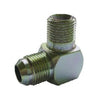
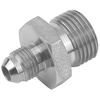
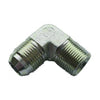
Mixed-origin equipment is everywhere in UK industry, and the four hydraulic end fitting standards that come with it, including BSP, JIC, ORFS, and metric DIN, all look broadly similar. They screw together in ways that can seem convincing right up until the system is under pressure.
Understanding what each one is, how it seals, and how to tell them apart before you order is therefore vital. In this article, we cover all four standards in detail. Keep reading to learn more…
Why end-fitting standards matter more than you think
The most expensive hydraulic fitting problem is a fitting that almost works.
When two incompatible thread standards engage partially (the most common scenario being a JIC fitting screwed into a BSP port or a metric compression fitting run up against an ORFS face), the threads make contact at wrong angles. There's resistance, but three turns in, it snugs up.
The engineer torques it to feel, the system comes up to pressure, and it weeps. Tighten it again, and it weeps a bit less. Leave it, and it gradually gets worse, or it holds for a month and then fails completely under a surge.
By the time anyone traces the fault back to a standard mismatch, the original fitting may have been changed twice, and the system documentation is even further from the truth.
BSP is the UK and European default. But it's not the only standard on most UK sites. Agricultural machinery from American manufacturers uses JIC almost universally. Plant equipment from Germany runs metric DIN.
Newer mobile hydraulics (excavators, telehandlers, and lifting equipment) are increasingly specced with ORFS regardless of where they were built because the standard handles vibration better than any thread-based seal.
The problem is knowing which one you're looking at when you're under a machine with a failing line and a hose to replace. Two fittings being the same nominal size does not mean they're interchangeable but that the thread may engage.
A 1/2" BSP fitting and a 1/2" JIC fitting will not mate at all, but a BSP port and a metric DIN fitting at certain sizes may partially thread together because the pitch is close enough to catch.
The confusion comes from the word "interchangeable" being used loosely to mean "fits" when it should mean "seals correctly under rated pressure".
This article uses "compatible" to mean "creates the correct seal at the rated working pressure for that standard". Anything less is not compatible, regardless of whether it threads together.
BSP: the UK default
BSP (British Standard Pipe) covers two thread forms that look identical but seal in completely different ways. Getting this wrong is one of the most common sources of hydraulic leaks. BSP actually consists of two different fittings:
BSPP (British Standard Pipe Parallel, also designated G thread per ISO 228-1:2000) has a constant thread diameter along its full length. The thread angle is 55°, with rounded peaks and valleys. It does not taper. Because a parallel thread cannot wedge itself into a seal, BSPP cannot seal on the thread. The seal comes entirely from a bonded washer or O-ring compressed between the face of the female port and the shoulder of the male fitting. The threads hold the fitting mechanically, while the face seal does the sealing.
BSPT (British Standard Pipe Tapered, also designated R thread per ISO 7) has the same 55° angle and the same rounded Whitworth profile, but the thread tapers at 1:16 along its length. The taper creates increasing metal-to-metal contact as the fitting is tightened, and the seal comes from that interference, aided by PTFE tape or thread sealant filling the spiral leak path.
The two look almost identical. The tell is whether the thread diameter reduces towards the tip or stays constant.
When BSPP is correct and what face seal it needs
BSPP is the dominant form in UK hydraulic ports, pneumatic manifolds, and industrial fittings. If a drawing or spec sheet says "BSP" without further qualification, it almost certainly means BSPP.
The seal requires a bonded washer or O-ring at the face, installed correctly and in good condition. Without it, no amount of torque creates a seal. You're tightening a parallel thread into a parallel port, and the only thing happening is thread damage.
When BSPT is correct and why PTFE tape on a BSPP port is wasted effort
BSPT appears on gas lines, some older plumbing, and certain imported fittings. It's less common in day-to-day UK hydraulic work but appears frequently on agricultural and water transfer equipment.
Applying PTFE tape to a BSPP fitting is a mistake that gets made constantly. The tape sits on parallel threads that aren't doing any sealing. The face seal is either missing or compromised. The fitting looks assembled and leaks. The fix is the correct face seal.
BSP in UK industrial, pneumatic, and hydraulic systems
BSP thread dimensions per ISO 228-1:2000 for the sizes most commonly encountered in hydraulic applications:
|
Nominal size |
Major OD (mm) |
Pitch diameter (mm) |
TPI |
Thread angle |
|
1/8" |
9.728 |
9.147 |
28 |
55° |
|
1/4" |
13.157 |
12.301 |
19 |
55° |
|
3/8" |
16.662 |
15.806 |
19 |
55° |
|
1/2" |
20.955 |
19.793 |
14 |
55° |
|
3/4" |
26.441 |
25.279 |
14 |
55° |
|
1" |
33.249 |
31.770 |
11 |
55° |
|
1¼" |
41.910 |
40.431 |
11 |
55° |
|
1½" |
47.803 |
46.324 |
11 |
55° |
Source: ISO 228-1:2000, Table 1. Values are for the G (BSPP) thread form. The BSPT (R thread) form shares the same nominal dimensions at the gauge plane but tapers at 1:16.
JIC: the American standard
JIC (Joint Industry Council) fittings to SAE J514 / ISO 8434-2 were developed for the American hydraulics and fluid power industry and remain the default on most American-built equipment. They appear on UK sites wherever that equipment does, such as agricultural machinery, mining equipment, construction plant, and anything imported from North America.
The practical rule to see if you’re dealing with JIC is if the machine has a VIN or serial number that starts with a US manufacturer code or if it was built primarily for the American market before being sold into the UK, assume JIC until you've measured it.
The 37° flare
JIC sealing has nothing to do with the threads. The threads pull the fitting together, and the seal is made entirely by metal-to-metal contact between a 37° conical seat on the fitting body and a 37° flare on the tube end (74° included angle, machined with a flaring tool, not by hand).
When the nut is tightened, the flared tube end seats against the fitting cone. As the two surfaces compress, the metal deforms slightly and a leak-free seal forms. There is no gasket, no O-ring, and no sealant involved in a standard JIC connection.
JIC thread sizes per SAE J514, mapped to pipe outside diameter:
|
Pipe OD (metric) |
Pipe OD (inch) |
JIC thread (UNF) |
Max working pressure (carbon steel) |
|
6 mm |
1/4" |
7/16-20 |
450 bar |
|
8 mm |
5/16" |
1/2-20 |
450 bar |
|
10 mm |
3/8" |
9/16-18 |
350 bar |
|
12 mm |
1/2" |
3/4-16 |
350 bar |
|
14–16 mm |
5/8" |
7/8-14 |
350 bar |
|
18–20 mm |
3/4" |
1-1/16-12 |
350 bar |
|
25 mm |
1" |
1-5/16-12 |
290 bar |
|
30–32 mm |
1-1/4" |
1-5/8-12 |
240 bar |
|
38 mm |
1-1/2" |
1-7/8-12 |
240 bar |
Source: SAE J514 / ISO 8434-2 dimensional data
Because JIC relies on metal-to-metal contact, overtightening deforms the flare seat. Once deformed, the sealing surface no longer makes clean contact, and the connection leaks at the damaged point rather than along the thread. Re-tightening makes it worse.
The correct approach when a JIC fitting leaks is to inspect the flare. If it's damaged, the tube end needs to be cut back past the damage and re-flared before reassembly. Adding sealant to a JIC thread may temporarily reduce the leak, but the underlying problem remains.
ORFS: the high-pressure standard
ORFS (O-Ring Face Seal) fittings to SAE J1453 were developed specifically to address the limitations of JIC in high-pressure and high-vibration applications. Most hydraulic system designers specifying new equipment today use ORFS in preference to JIC wherever the application demands it.
The ORFS seal is made by compressing an elastomeric O-ring between the flat face of a female fitting and the flat machined face of a male fitting. The pipe end is flared at 90° (a simple right-angle flare, unlike the 37° JIC cone). The O-ring sits in a groove machined into the face of the male fitting.
The result is a seal that works independently of the metal-to-metal contact quality. Where JIC requires the flare surfaces to be in near-perfect condition, ORFS seals reliably even with minor surface imperfections because the O-ring conforms to the face. Under vibration, the O-ring maintains positive sealing contact even as the fitting flexes slightly. JIC, being metal-to-metal, can lose contact under the same conditions.
ORFS thread sizes per SAE J1453, mapped to pipe outside diameter:
|
Pipe OD (metric) |
Pipe OD (inch) |
ORFS thread (UNF) |
Max working pressure (carbon steel) |
|
6 mm |
1/4" |
9/16-18 |
630 bar |
|
8–10 mm |
5/16–3/8" |
11/16-16 |
630 bar |
|
12 mm |
1/2" |
13/16-16 |
630 bar |
|
14–16 mm |
5/8" |
1-14 |
420 bar |
|
18–20 mm |
3/4" |
1-3/16-12 |
420 bar |
|
22–25 mm |
7/8–1" |
1-7/16-12 |
420 bar |
|
28–32 mm |
1-1/4" |
1-11/16-12 |
280 bar |
|
35–38 mm |
1-1/2" |
2-12 |
280 bar |
Source: SAE J1453 dimensional data
ORFS in mobile hydraulics, construction equipment, modern assemblies
ORFS is now standard on most new mobile hydraulic equipment, excavators, agricultural machinery built from the mid-2000s onwards, telehandlers, cranes, and lifting equipment.
Caterpillar, John Deere, and most other major OEMs have moved to ORFS as their default hydraulic connection on high-pressure circuits. If you're working on equipment manufactured in the last fifteen years from any of the major OEMs, ORFS is the likely standard.
The O-ring condition
An ORFS fitting with a damaged, missing, or incorrectly sized O-ring will leak. Unlike JIC, where the fitting itself forms the seal, ORFS relies entirely on the O-ring being present and intact. When an ORFS fitting is disassembled, the O-ring should be replaced as a matter of course, as they're cheap, and reusing a compressed O-ring from a previously tightened connection is a false economy.
O-ring material matters for fluid compatibility. NBR (nitrile) is standard for hydraulic oil. For phosphate ester fluids, water-glycol hydraulic fluids, or biodegradable hydraulic oils, check compatibility before fitting and specify accordingly.
ORFS and JIC
ORFS and JIC fittings are hard to distinguish. Both use UNF threads, have similar body proportions, and share some thread sizes at certain nominal diameters.
The best identification method is the sealing face. Unscrew the fitting and look at the male end face-on. A JIC fitting has a 37° conical seat, a visible angle going into the fitting body. An ORFS fitting has a flat face with an O-ring groove visible as a circular channel machined into it. Once you know what you're looking for, the difference is unambiguous.
Do not attempt to mate JIC and ORFS fittings. The thread sizes overlap at some nominal sizes (both use 9/16-18 at the 1/4" size, for example), and the fittings will engage, but neither seal will form. The JIC cone won't seat against the flat ORFS face, and the O-ring will be displaced rather than compressed.
Metric DIN: the European standard
DIN 2353, now published as ISO 8434-1, is the standard for compression fittings on metric tubes used across continental European industry. Any machine built to German, French, or broadly European specification will use metric DIN connections on its hydraulic circuits. It's also common on Italian agricultural equipment and Scandinavian forestry machinery.
DIN 2353 / ISO 8434-1: what the standard covers
DIN 2353 is a compression fitting system. The tube end is not flared. Instead, a ferrule (cutting ring) is compressed onto the tube OD as the nut is tightened against a 24° conical seat in the fitting body. The ferrule bites into the tube, forming both the mechanical hold and the seal.
The standard covers tube ODs from 4mm to 42mm. Thread sizes are metric, specified as diameter × pitch (e.g., 14×1.5mm, 18×1.5mm, 24×1.5mm). The 24° cone angle is the key identification feature and the key danger point, as it looks similar enough to the 37° JIC cone that the two are regularly confused.
DIN 2353 sizes for the most common hydraulic tube ODs, with corresponding metric threads and series:
|
Tube OD (mm) |
L series thread |
L series max pressure |
S series thread |
S series max pressure |
|
6 mm |
12×1.5 mm |
400 bar |
14×1.5 mm |
630 bar |
|
8 mm |
14×1.5 mm |
400 bar |
16×1.5 mm |
630 bar |
|
10 mm |
16×1.5 mm |
400 bar |
18×1.5 mm |
630 bar |
|
12 mm |
18×1.5 mm |
400 bar |
20×1.5 mm |
630 bar |
|
15 mm |
22×1.5 mm |
315 bar |
22×1.5 mm |
— |
|
16 mm |
22×1.5 mm |
315 bar |
24×1.5 mm |
400 bar |
|
18 mm |
26×1.5 mm |
315 bar |
26×1.5 mm |
— |
|
20 mm |
30×2 mm |
315 bar |
30×2 mm |
400 bar |
|
25 mm |
36×2 mm |
250 bar |
36×2 mm |
400 bar |
|
30 mm |
42×2 mm |
250 bar |
42×2 mm |
315 bar |
|
38 mm |
52×2 mm |
— |
52×2 mm |
315 bar |
Source: ISO 8434-1/DIN 2353
The 24° cone vs the 37° JIC flare
The 24° DIN cone and the 37° JIC cone look similar. Both are conical seats and are used in high-pressure hydraulic applications. However, the thread sizes are completely different (metric vs UNF), so they don't physically engage, but trying to identify an unmarked fitting from appearance alone can easily mistake one for the other.
The test to tell them apart is that if the thread is metric pitch (measured in mm), it's DIN. If the thread is UNF (threads per inch, imperial pitch), it's JIC or ORFS. A thread pitch gauge resolves any doubt quickly.
L series vs S series
Within DIN 2353, the L series (light duty) and S series (heavy duty) cover different pressure ranges for the same tube OD:
-
L series uses a single-bite cutting ring
-
S series uses a heavier body and higher working pressures
The two are not interchangeable. The thread sizes differ at the same tube OD, and the fitting bodies are dimensionally different.
If you're replacing a DIN fitting and can't read the markings, measure the thread. At 6mm tube OD, L series uses a 12×1.5mm thread, and the S series uses a 14×1.5mm. At 12mm tube OD, the L series is 18×1.5mm and the S series is 20×1.5mm.
Which machines bring metric DIN onto UK sites
German construction equipment (Liebherr, Putzmeister, Schwing), German and Italian agricultural machinery (Claas, Deutz-Fahr, Same, Fendt), Scandinavian forestry and construction plants (Volvo CE, Sandvik, Epiroc), and any machinery manufactured to DIN specifications. French equipment often uses a variant with GAZ fine threads and a 24° cone, which is broadly compatible with DIN 2353 but worth verifying before assuming direct interchange.

How to identify which standard you have
Step 1: establish country of origin
UK and European (including German) equipment: BSP or metric DIN. American or Canadian equipment: JIC or ORFS. Modern mobile hydraulics regardless of origin: probably ORFS on the high-pressure circuits.
This narrows the field before you pick up a measuring tool.
Step 2: check for taper, parallel, or flare
Run the thread between your fingers along its length:
- Does the diameter reduce towards the tip? That's either BSPT or metric DIN (compression, not a thread seal).
- Does the diameter stay constant? That's BSPP or a JIC/ORFS nut thread, both of which are parallel because the seal isn't made on the thread.
Then look at the sealing face end-on. If it's a cone, it's JIC or DIN, a flat face with a groove is ORFS, and a flat face with no groove is BSPP (the seal is at the port face, not the fitting face).
Step 3: measure OD and thread pitch
Measure the OD of a male thread at the fourth full thread from the tip (the gauge plane). Then count TPI with a ruler or use a pitch gauge.
An OD of around 20.96 mm with 14 TPI is 1/2" BSP. An OD of 14.29 mm (9/16") with 18 TPI is JIC or ORFS at the 3/8" pipe size. A metric thread pitch (1.5mm or 2.0mm) points to DIN.
Step 4: examine the sealing face
Unscrew the fitting and look at the male end directly:
- A 37° conical seat going into the fitting body = JIC (SAE J514)
- A flat face with a circular O-ring groove = ORFS (SAE J1453)
- A 24° conical seat = metric DIN (ISO 8434-1)
- A parallel face with a shoulder recess for a bonded washer = BSPP (ISO 228-1)
Hydraulic end-fitting standards reference table
|
Standard |
Thread type |
Thread angle |
Sealing method |
Sealing face |
Typical origin |
|
BSPP (G) |
Parallel |
55° Whitworth |
Face seal (bonded washer or O-ring) |
Flat with shoulder recess |
UK, Europe, Australia |
|
BSPT (R) |
Tapered 1:16 |
55° Whitworth |
Thread interference + sealant |
Tapered thread |
UK, older plumbing/gas |
|
JIC (SAE J514) |
Parallel UNF nut |
— |
Metal-to-metal 37° flare |
37° cone on fitting body |
USA, North America |
|
ORFS (SAE J1453) |
Parallel UNF nut |
— |
O-ring on flat face |
Flat face with O-ring groove |
Modern mobile hydraulics, OEM |
|
Metric DIN (ISO 8434-1) |
Metric (mm pitch) |
— |
Ferrule compression, 24° cone |
24° cone on fitting body |
Germany, continental Europe |
Connecting across standards
BSP to metric DIN
This is the most frequent mismatch, and the answer is a purpose-made BSP-to-metric adaptor with BSPP on one end and metric DIN male on the other.
Both sides seal correctly for their own standard: O-ring or bonded washer at the BSP face, compression ferrule at the DIN end.
Do not attempt to use any thread sealant to bridge the standards, as the sealing methods are incompatible and sealant won't compensate for a mismatched cone angle.
BSP to JIC
A straight nipple with a BSP male thread on one end and JIC on the other is a standard catalogue item.
When ordering, confirm which end is which (the body marking or code will show the thread type for each end), confirm male or female on each, and verify the nominal sizes. They won't necessarily match: a 3/8" BSP port and a 1/2" JIC fitting can both be in a 3/8" nominal line depending on how the system was spec'd.
The BSP end seals with an O-ring or bonded washer as normal. The JIC end seals on the 37° flare as normal. The adaptor doesn't change either seal, as it just transitions between thread forms.
JIC to ORFS
If you're rebuilding a hydraulic circuit on older American equipment and the JIC connections have a history of weeping under vibration, it's worth considering converting to ORFS at that point.
The thread sizes overlap at several nominal diameters; JIC-to-ORFS adaptors are readily available, and the ORFS seal is less sensitive to flare conditions and vibration than JIC.
ORFS O-rings are cheap, the seal is reliable, and you eliminate the risk of flare damage on a circuit that's been in service for years.
What not to do
Thread sealant compensates for minor imperfections within a correctly matched standard. It does not compensate for mismatched cone angles, incompatible thread forms, or missing face seals.
Applying PTFE tape or paste to a connection that's leaking because of a standard mismatch delays the diagnosis and often results in the correct fix being applied after something has failed under pressure rather than before.
If a fitting leaks and you're not certain what standard it is, identify it first. The identification steps above take five minutes. The consequences of guessing wrong can take considerably longer to resolve.
Which standard to specify on a new build or rebuild
BSP for UK-only systems and general industrial use
If the entire system is UK-built, the equipment it connects to uses BSP ports, and it won't travel to North America or need to mate with American components, BSP is the right choice. BSPP is the correct form in almost all cases. Use proper face seals (bonded washers or O-rings) and don't improvise with PTFE tape on parallel threads.
ORFS where pressure, vibration, or cycle count is high
Mobile hydraulics, anything on a vehicle or machine with significant vibration, high-pressure circuits above 250 bar, and systems that will see a high number of pressure cycles should use ORFS. The O-ring seal is more tolerant of the conditions that cause JIC to weep over time, and the higher pressure ratings at small bore sizes (630 bar at 6–12 mm OD) make it suitable for modern high-pressure hydraulics.
JIC where you're maintaining continuity with existing American equipment
If the machine is American-built and JIC throughout, and you're replacing a hose rather than redesigning a circuit, use JIC. Mixing JIC and ORFS on the same circuit adds complexity without benefit. Keep it consistent, inspect the flares at every service, and replace tube ends at the first sign of flare damage rather than trying to reseal a compromised seat.
Metric DIN where the rest of the machine is already DIN
The same logic applies. Continental European equipment built to DIN 2353 should be maintained with DIN fittings. Confirm the L or S series before ordering, as this is one of the most common ordering errors on DIN jobs, and the thread size difference means a wrong-series fitting simply won't make up correctly.
Frequently asked questions
Are JIC and ORFS interchangeable?
No. Both use UNF threads, and some sizes share the same thread designation, but they cannot create a reliable seal with each other. JIC seals on a 37° metal cone, and ORFS seals on a flat face with an O-ring. Mating the two produces neither seal. At nominal sizes where the threads engage, the result is a fitting that appears assembled but leaks under pressure.
Can you use a JIC fitting on an ORFS port?
At sizes where the threads match (such as 9/16-18 at the 1/4" nominal size), the fitting will screw into the port. It will not seal. The JIC 37° cone has no mating surface on the flat ORFS face. Do not do this.
What does the dash size mean on a hydraulic fitting?
The dash number in American hydraulic fitting catalogues refers to the nominal tube OD in sixteenths of an inch. A -6 fitting is for a 6/16" (3/8") OD tube; a -12 is for a 12/16" (3/4") OD tube. The same convention applies to JIC and ORFS. Metric DIN fittings use tube OD in millimetres directly, so a 12mm DIN fitting is for a 12mm OD tube.
How do I measure a JIC fitting?
Measure the OD of the male thread and count TPI. A 9/16" OD with 18 TPI is the 9/16-18 JIC thread, used for a 3/8" (10 mm) OD tube. Cross-reference against the JIC thread table above. If you have the fitting in hand, look at the cone angle end-on: a 37° cone confirms JIC; a flat face with an O-ring groove confirms ORFS.
Is BSPP the same as G thread?
Yes. BSPP and G thread are two designations for the same thread form, covered by ISO 228-1:2000. G is the ISO designation; BSPP is the common British usage. Both refer to the parallel form that seals on a face seal rather than on the threads.
What is the difference between DIN L series and DIN S series?
Both are DIN 2353 / ISO 8434-1 compression fittings. The S (heavy) series has a larger thread at the same tube OD, a heavier body, and a higher pressure rating. At 6 mm OD, the L series uses a 12×1.5 mm thread (400 bar); the S series uses a 14×1.5 mm thread (630 bar). They are not interchangeable at the same tube OD, as the thread sizes differ, and a fitting from one series will not make up correctly into a port from the other.
Shop hydraulic fittings and adaptors at The Hosemaster
Identifying which standard you're working with before ordering takes five minutes and a measuring tool. Identifying it after a failed connection takes considerably longer. At The Hosemaster, we stock a wide range of hydraulic fittings and adaptors to help suit your needs.
If you require additional support or buying advice, we’re always happy to help. Contact us online with any sales or technical questions, or give us a call on 01282 604 002 to speak to one of our team at any stage of your buying journey.
Browse hydraulic fittings and adaptors at The Hosemaster
For more product buying guides and useful information, check out The Hosemaster blog…
Braided Hose: What Is It, and How Do You Use it? | PVC vs Rubber Fuel Hose: Which Is Best for You? | What Is a Jubilee Clip & How Do You Use One?
References:
ISO 228-1 (BSPP) | BS EN 10226 (BSPT) | ISO 8434-1 | DIN 2353 | SAE J514 | SAE J1453


