



To check tyre pressure, find your car's recommended figure, measure each tyre while it's cold, then add or let out air until the gauge matches. The method takes five minutes. Whether the result is right depends on two things: using the correct figure for the load you're carrying and a gauge that reads true.
What should my tyre pressure be?
The figure for your car is on a sticker, usually inside the driver's door frame or on the fuel filler cap, and in the vehicle handbook. Ignore the number moulded into the tyre sidewall: that's the most the tyre can take, not what your car needs.
The sticker normally gives more than one figure:
-
Front and rear. They're often different, so don't set all four the same unless the sticker says so.
-
Normal and full load. The Highway Code says tyres must be inflated to the manufacturer's specification "for the load being carried", so use the higher figure when the car is full of people or luggage.
-
Electric vehicles. The RAC notes that EVs often need slightly higher pressures because of the weight of the battery. Use the figure for your model.
PSI, bar and kPa
UK forecourt machines and gauges usually show psi and bar, and some show kPa. 1 bar is 14.5 psi, and 1 psi is about 6.9 kPa. Common car pressures convert like this:
|
psi |
bar |
kPa |
|
26 |
1.79 |
179 |
|
28 |
1.93 |
193 |
|
30 |
2.07 |
207 |
|
32 |
2.21 |
221 |
|
33 |
2.28 |
228 |
|
35 |
2.41 |
241 |
|
36 |
2.48 |
248 |
|
38 |
2.62 |
262 |
|
40 |
2.76 |
276 |
|
44 |
3.03 |
303 |
How to check your tyre pressure
-
Start with cold tyres. The Highway Code warns that warm or hot tyres can give a misleading reading. The RAC suggests leaving the car for three to four hours after driving.
-
Find your figure on the door frame or fuel cap sticker, for the load you're carrying.
-
Take off the valve cap and put it somewhere you'll find it.
-
Press the gauge squarely onto the valve until the hiss stops, then read it. A short hiss as it goes on is normal; a steady one means it isn't seated.
-
Check all four tyres, and the spare if you have one.
-
Refit the valve caps. They keep dirt out of the valve core.
The Highway Code says to check weekly and before a journey. If you can only check after driving, at a forecourt for example, expect a higher reading than the cold figure, and don't let air out to bring a warm tyre down to it.
Forecourt machine or your own gauge?
Forecourt machines do the job, and many let you set a target pressure with plus and minus buttons. What you can't know is when that machine was last checked, and you'll usually arrive with warm tyres. A gauge of your own lets you take a cold reading at home and compare one week with the next.
How to inflate your tyres
-
Fit the connector to the valve. On a clip-on connector, push it on and close the lever; on a screw-on one, thread it on finger tight.
-
Add air in short bursts and check the reading between each. If your inflator lets you set a target, set it to the figure for your load.
-
If you overshoot, let a little out and check again.
-
Remove the connector quickly so you don't lose air, then refit the cap.
To let air out, press the pin in the centre of the valve briefly with the tip of the gauge or a valve tool, or use the deflate button on an inflator, then check again. A tyre that keeps losing pressure from the valve may have a leaking valve core, which a valve core tool lets you replace.
Which tyre gauge or inflator do you need?
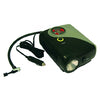
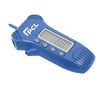
It depends on where the air comes from. A handheld gauge only measures. A 12V inflator makes its own air from the car's socket. An air-line inflator runs off a compressor and is what workshops and forecourts use.
|
Product |
Type |
Key specification |
Suits |
|
Handheld digital gauge |
Pressure and tread depth in one tool; switches itself off after 90 seconds |
Glovebox checks |
|
|
12V compressor |
Digital display in bar, kPa, psi or kg/cm²; adaptors for airbeds, bikes and balls |
Topping up at home or at the roadside without an air line |
|
|
Air-line inflator |
10 to 210 psi, accurate to 0.1 bar (2 psi); 0.85 m hose; Euro clip-on; max inlet 15 bar |
Home garages and small workshops with a compressor |
|
|
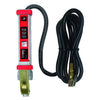
Air-line inflator, analogue scale |
0 to 138 psi (0 to 9.6 bar), ±2 psi between 25 and 75 psi; dual-angle hold-on chuck; max supply 200 psi |
Workshops wanting a simple analogue inflator |
|
|
Workshop air-line inflator |
Complies with EC 86/217 and EN 12645:2014; tested to over 400,000 cycles |
Busy workshops |
|
|
Digital air-line inflator |
4 to 250 psi (0.3 to 17.2 bar); reads psi, bar or kPa; backlit; 0.53 m hose; twin hold-on connector |
Workshops handling cars and higher-pressure vehicles |
Two checks before you buy an air-line inflator. First, keep the supply below its maximum inlet pressure: a filter regulator on the line does that and takes out water and dirt. Second, match the connector to how you work. Clip-on connectors stay on the valve while you use both hands; hold-on connectors are quicker for checking a row of tyres. Our tyre valve connectors come in clip-on, screw-on and hold-on types, with straight or angled bodies.
What happens if tyre pressure is too low or too high?
Too low, and the tyre flexes more as it rolls. It runs hotter, wears faster on the outer edges and makes the steering feel vague. Too high, and less of the tread touches the road, so grip and ride comfort both suffer and the centre of the tread wears first. Over-inflating doesn't buy you better fuel economy either: the RAC points out that a stiffer tyre takes more effort over bumps and broken surfaces.
Why is my tyre pressure warning light on?
Many cars have a tyre pressure monitoring system (TPMS). The light comes on when the system detects a drop in pressure, and it can also mean the system itself has a fault. Check all four tyres cold with a gauge and inflate them to the correct figure. If the light stays on, check the handbook: some systems need a reset after you've corrected the pressures, and a light that won't clear may point to a faulty sensor.
The MOT checks it on cars first used on or after 1 January 2012: a TPMS that's malfunctioning or obviously not working is a major defect. A tyre that's obviously under-inflated is a minor defect.
Is incorrect tyre pressure illegal?
It can be. The Highway Code says tyres "MUST be correctly inflated to the vehicle manufacturer's specification for the load being carried". In Highway Code terms, "must" means it's a legal requirement. The law behind it, Regulation 27 of the Road Vehicles (Construction and Use) Regulations 1986, says a tyre mustn't be so under-inflated that it's unfit for the use the vehicle is being put to.
Frequently asked questions
How often should I check my tyre pressure?
Weekly and before a long journey, according to the Highway Code. The RAC's minimum is once a month. Check the spare at the same time, if you have one.
Should I check tyre pressure hot or cold?
Cold. Pressure rises as a tyre warms up, so a reading taken straight after driving will be higher than the figure on your sticker. The RAC suggests waiting three to four hours after a drive.
What happens if tyre pressure is too high?
Less of the tread touches the road, so you lose grip and the ride gets harsher, and the centre of the tread wears out first. Let air out until the cold reading matches the figure for your load.
What is 2.2 bar in psi?
About 32 psi. Multiply bar by 14.5 to get psi, or divide psi by 14.5 to get bar. The conversion table above covers the common car pressures.
Can I use a workshop compressor to inflate car tyres?
Yes, with a tyre inflator connected to the air line. Keep the supply below the inflator's maximum inlet pressure: 15 bar on our Alloy Tyre Inflator and 200 psi on the Jamec TDR2000. A filter regulator on the line sets the pressure and catches water and dirt.
Need a gauge or inflator?
Shop our tyre inflation equipment, from handheld gauges to workshop inflators and valve connectors. If you're not sure which inflator suits your compressor, ring us on 01282 604 002 with the supply pressure and the fitting on your air line.
Related guides
References
The Highway Code, Annex 6: vehicle maintenance, safety and security | Road Vehicles (Construction and Use) Regulations 1986, Regulation 27 | MOT inspection manual, section 5: axles, wheels, tyres and suspension | RAC: how to check your tyre pressure | EN 12645:2014, tyre pressure measuring instruments


